Memory Remixed through Downsampling
Across several projects our work has involved taking something familiar, breaking it apart, and building it back together again.
At first this emerged through observation. Later it became methodology. Now it feels closer to a way of thinking.
Austin Kleon’s Steal Like an Artist suggests creativity doesn’t come from nowhere
it grows through connection.
Ideas are absorbed, translated, and reshaped. Nothing exists in isolation; each work is a continuation of another. I’ve come to realise my own projects are less separate bodies of work and more chapters of the same investigation.
The BBC News Project
In The One Minute World News: Deconstructed and Reconstructed, I condensed a sixty-second news broadcast into a single image by extracting one vertical column of pixels from every frame of the video.
Time was flattened.
Events became stripes.
Meaning became pattern.
Sometimes a face appeared if it stayed on screen long enough. More often it dissolved into motion in the blink of an eye.
Life is therefore seen, processed, and forgotten simultaneously. Or, to align this idea with popular culture, it is like remembering the last three reels you watched on Instagram.
The piece reflected how information is consumed: quickly understood, quickly replaced. We rarely remember the full story; we remember fragments and impressions. The image functioned as a visual memory of an event rather than the event itself.
The Remix Portraits
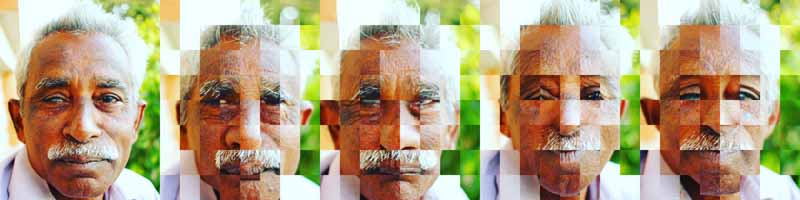
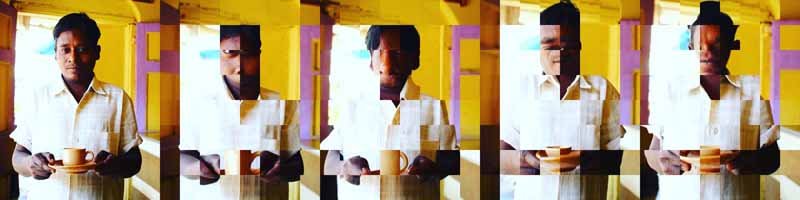
Later, in the portrait Remix project, the focus shifted from time to recognition.
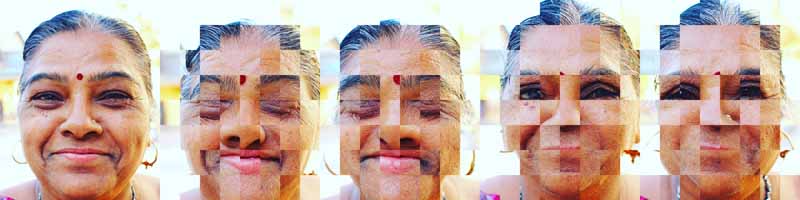
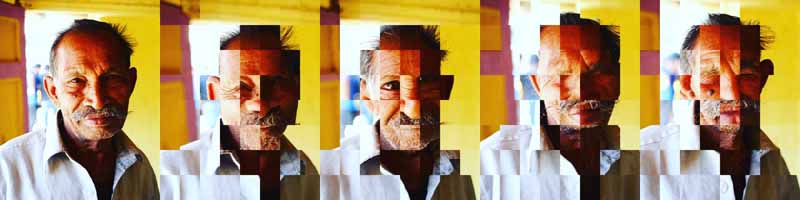
Faces were dismantled into parts (eyes, noses, mouths) and rebuilt incorrectly. The results looked familiar but unresolved, like trying to recall someone you once knew well but can’t quite picture anymore.
The discomfort came from the brain attempting to complete the image.
We recognise structure before accuracy.
Here the question wasn’t what did we see?
It became how do we remember what we see?
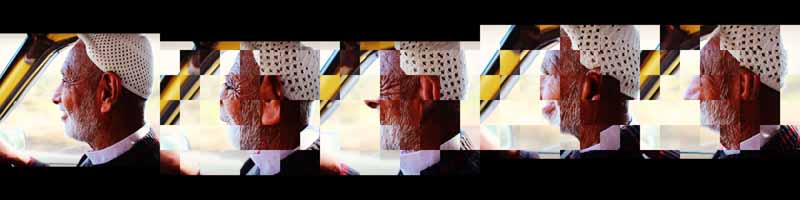
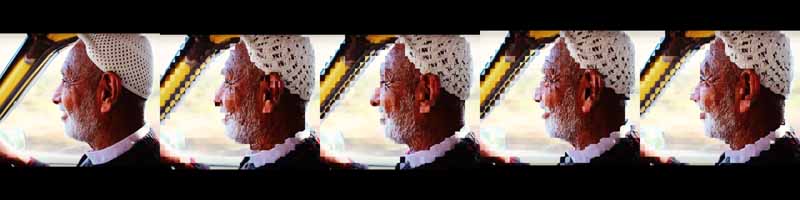
Downsampling
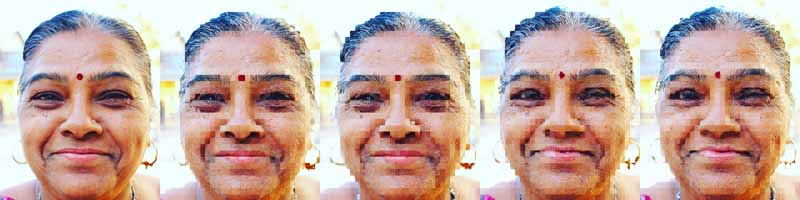
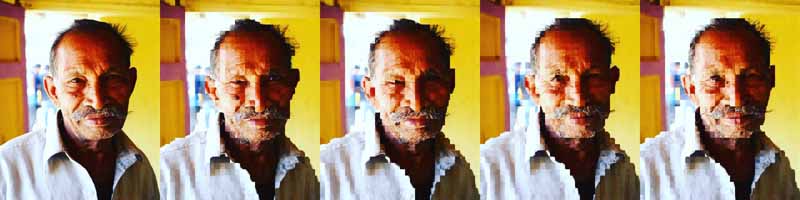
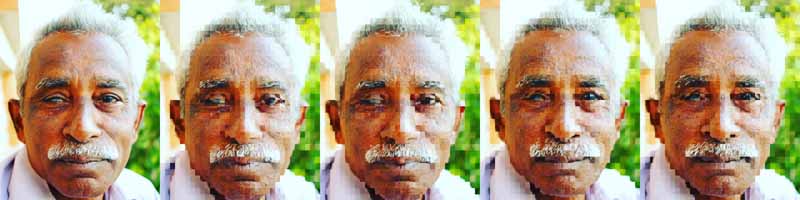
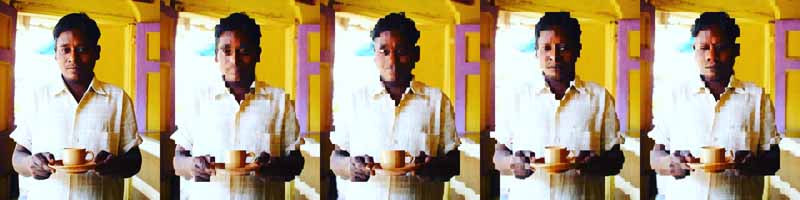
Now, here and more recently I’ve been thinking about downsampling as a kind of visual forgetting.
In this process the photograph is standardised (same aspect ratio, same dimensions) then reduced to a small set of equal-width slices. Instead of losing information through blur or compression, it loses coherence through structure. The image becomes a handful of samples that can be rearranged.
The strips are reassembled out of sequence (odd columns first, then even), and then the whole procedure is repeated after rotating the image. The photograph is reconstructed twice from partial readings, like an event remembered, revisited, and subtly rewritten.
The source image stays present, but it becomes unstable: still there, but no longer fully reliable.
This returns to the idea of creative lineage. Just as artists build upon artists, perception builds upon perception. We never experience the world directly; we interpret it through layers of previous images, references, and expectations.
To “steal like an artist” is simply to acknowledge this process consciously and to work with influence rather than deny it.
These new images are made from photographs taken over years of travel, but they are less about place than recollection. They resemble memories more than documents: partial, repeating, and slightly misaligned.
Not inaccurate, just human.
The work doesn’t attempt to preserve moments exactly as they were.
It reflects how they exist now.
Reassembled.