Learning to Call a Place “Home” Again.
When I asked him where home is, he didn’t answer the way most people do.
He paused, then looked at me as if the question itself had sharp edges. Home, he said, is never that simple.
I’m always slightly unsure when I sit down with someone and the first question doesn’t land the way I expect. Before we begin, I try to make sure participants understand the direction of the interview:
That I don’t work for the Dutch government. I’m only a local artist, exploring themes that directly and indirectly relate to my own life.
I then go on to say that my grandparents and father were part of the Windrush generation in the UK. While I’ve never had to flee persecution or cross borders illegally, I have left my motherland and settled somewhere foreign. I too live somewhere where the language is different, the culture is different, and the attitudes don’t always align with what I grew up with. I often share this background because it sits close to my heart.
But I always make it ver clear that although I’ve never crossed a border under the same conditions.
I did once attempted to retrace part of my grandparents’ journey by cycling across the Atlantic route from London to Barbados over the course of a year. It’s not the same. Not even close. But it’s the closest I could come to understanding the emotional weight of displacement, even conceptually.
So when we sat down and I opened with my warm-up question, he explained that home isn’t a pin on a map. Nigeria is where he is from. But the Netherlands is where he is trying to become himself again. Even that, he said, is complicated because he still doesn’t yet have a home of his own.
My interviewee is now in his late twenties, but he left Nigeria as a teenager. What pushed him to leave wasn’t a single event, but a knot of grief, family conflict, and fear. His father who taught him fashion design, discipline, and a particular way of carrying himself in the world was murdered. With that loss came the fear of retaliation and consequences that felt impossible to escape.
The grief still sits close to the surface. He spoke quietly about his father not only as a parent, but as a compass:
“My father is my teacher… my master.”
He didn’t talk about inheritance in legal terms. Instead, he described it as something emotional and personal. aligning it toward something that can turn relatives into enemies, echoing the ancient conflicts of jealousy and greed found in every religious text.
As we talked, he told me about conflict with an uncle. After confronting him, he felt hunted. In his telling, the danger was no longer abstract. It was immediate. So he left. He had to leave. Not alone, but with the help of his father’s friend, heading north across the Sahara Desert into Niger.
What followed is a route that has become familiar in European headlines and statistics. Its a route which rarely feels real until you hear it spoken slowly, vibrating from the voice of someone who lived it. It lands differently.
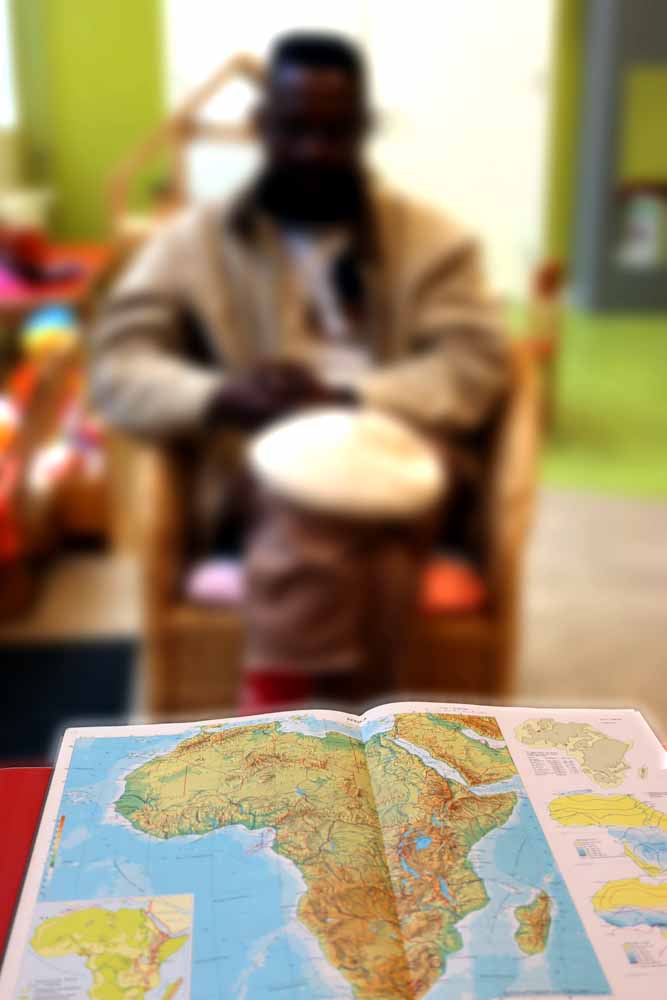
He travelled north through Niger, passing through Agadez, then into Libya. He admitted he wasn’t prepared. He was young and didn’t fully understand what he was walking into. When I showed him a map of North Africa, he struggled to point out any locations, even Nigeria. But when I found the starting point and moved my hand due North he knew their names before my finger reviled the writing below.
Trauma doesn’t always leave behind clean geography.
Crossing the desert is as simple as buying an overnight bus ticket in South East Asia. It was a gamble with life. He described people clinging to trucks, gripping metal rails because falling off meant being abandoned. “If anybody died there… we dig the sand, we cover,” he said: flat and very very factual, as if the mind protects itself by turning horror into routine.
Libya is where his story becomes both sharper and more guarded. He spoke about extortion, intimidation, and violence. About not knowing who to trust. “Do you trust people with guns?” he asked. Some of the pain still sits visibly in his body as he tells these stories.
At the same time, he pushed back against a single narrative. Not everyone in Libya, he said, was responsible for harm. He distinguished between ordinary people and those who exploit chaos. There was a tired precision in his voice. Its from the sound of someone who has spent years being reduced to headlines.
Then came the sea. The Mediterranean. While it is a holiday destination for many in northwestern Europe, its meaning shifts when seen from the southern shore. From Africa, it is no longer a place of escape. It becomes the route to escape.
He remembers the crossing because it never truly leaves him. The boat carried around a hundred people. Fear and confusion filled the air. Survival depended on more than the battered engine beneath them. Water leaked in. Fuel spilled. Someone was burned. One person died.
Eventually, rescue arrived. They were pulled aboard “one after the other” and brought toward Italy.
The journey took about a day: leaving at night and reaching rescue the following evening. But time behaves strangely in stories like this. Some moments stretch forever. Others disappear completely. What remains are fragments. Just like the memory of bread being shared.
In the middle of hunger and panic, one man broke what little food he had and passed it around. The interviewee still remembers his name. That small act carried enormous weight. Proof, he said, that even in the worst places, people still choose kindness.
Italy came first. The Netherlands came later.
He arrived in the Netherlands in 2019. What followed was not immediate safety, but years of waiting. Interviews, transfers, procedures, and uncertainty. He moved through so many camps that he eventually lost count. Each relocation reminded him that his life was suspended inside someone else’s system. It took nearly six years before he finally received his residence permit.
Throughout it all, he worked. He rejected the idea that people seek asylum for easy money. Support payments, he said, barely cover survival. You learn quickly how to economise and how to stretch food while saving small amounts, just to survive week to week. He then goes on to tell me that applying for work wasn’t a choice. It was a necessity.
Yet he doesn’t speak with bitterness about the country processing him. “They did not invite me,” he told me. “I bring myself.” He described the Netherlands as a place where he hasn’t felt openly targeted for being Black. Here is a place where people mind their own business, and where police, in his experience, come to calm situations rather than inflame them.
His only complaint came with a laugh: the cold.
Now in 2026 his focus is on the future. He wants his own apartment. A place he can call his own and a place where he can properly furnish it. He wants to learn Dutch fluently, because language, to him, means dignity and independence. He wants to travel across Europe with a freedom he couldn’t touch for years. And he wants to build a seamless bridge between past and future using his fashion skills.
Like his father, he is a designer. He has registered his brand in the Netherlands. Then when he speaks about his new secondhand sewing machine, his energy shifts. He becomes focused, animated, grounded. Explaining slowly that even when people disappoint him, he can always return to his work. The machine becomes something steady. Reliable. Something which he can control.
Underlying everything he says is a philosophy: patience, respect, and self-control. He believes your actions follow you. That intention matters. He avoids conflict not because he is weak, but because he understands what anger can unlock. In his world, quiet can be powerful and peace is something you choose repeatedly.
Eventually, we return to his father. His father didn’t leave him money. He left him a skill. A code. Something portable. Something strong enough to survive borders, camps, and years of waiting.
And perhaps that is the clearest definition of home he offers:
Not a country.
Not a building.
But a life to rebuild thread by thread. Stitch by stitch, until it finally fits.