A Certificate and the Search for Dignity: My Migration Story
In the heart of Accra, I was a dreamer fueled by ambition and a world-class education. I
imagined myself commanding courtrooms or newsrooms, never imagining that my
greatest journey would be defined not by a career ladder, but by a one-way ticket
across the ocean. This is the story of how my personal aspirations met with the societal
expectation, leading me from the warmth of Ghana to a new reality in the Netherlands.
Throughout my upbringing, my path seemed clear. I have always dreamed of becoming
a journalist or a lawyer. My education and personal life were promising until my mid-
twenties. I completed journalism school and finished my National Service with high
hopes. However, the reality of the professional world hit me hard. I struggled to find a
job in Ghana, primarily because the media sector relies heavily on connections and
networks with influential people. Unfortunately, I didn’t know anyone who could help
me get my foot in the door.
The pressure from my family, friends, and society began to mount. I felt the weight of
everyone’s expectations on my shoulders. To avoid being seen as “useless” or
becoming a burden to my mother, I decided to start my own business. Since I lacked
capital and business experience, I reached out to my father, who resides in the
Netherlands.
My father had not been part of my life during my upbringing, but when I contacted him,
he suggested that instead of sending money for a business, it would be better for me to
join him in the Netherlands to work. Traveling abroad has never been my dream. In
truth, I felt I was given no choice. I did not want to fail or be a burden to my mother and
society, so I succumbed to my father’s idea. I traded my childhood ambitions for a new
life in a foreign land, moving not out of a desire to leave, but out of the necessity to
survive and the pressure to succeed.
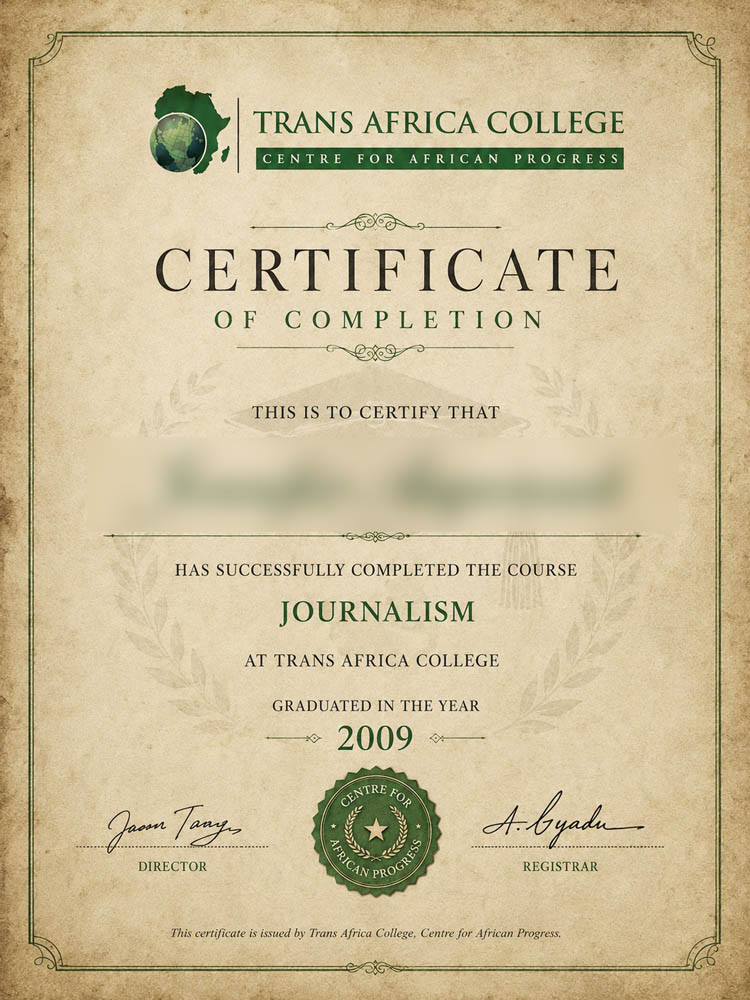
In April 2012, I left my home not just with a 10kg bag, but with something that felt even
more important: my certificate. It represented my education, my efforts, my
qualifications, and my future. I carried it carefully wrapped and protected between my
clothes, believing it would open doors wherever I went. My journey to Amsterdam was
smooth; I arrived documented on a direct flight from Ghana to Schiphol.
Before I left my motherland, that same certificate had become a symbol of frustration.
Despite my education, I could not find work. Systematic gaps make it nearly impossible
for many to find employment in their own country after acquiring an education.
Unemployment destroyed my confidence and stability. The constant reminders from
family, friends, and society about my lack of a job made me feel like a failure. Each day,
the certificate reminded me not of achievement, but of opportunities denied. What was
the value of being qualified if there was no place to prove it?
Migration became the solution to my frustration. Leaving home was not easy; I left
behind my family, my community, and my sense of belonging. But I carried the hope
that in the Netherlands, my certificate would finally mean something. I hoped my skills
would be recognized, allowing me to rebuild a life of dignity and satisfaction.
I stayed with my father, whose presence gave me strength and stability in a country
where everything felt unfamiliar. He provided not just a roof over my head, but the
emotional support I desperately needed. However, upon arriving, I realized that a
certificate alone was not enough. I was faced with new systems, higher expectations,
language barriers, and an unfamiliar working environment.
All of this made the journey more complex than I had anticipated. The certificate – once
a symbol of hope became something else, something I couldn’t yet name. I realized that
migration is not just about carrying out your qualifications; it is about adapting to a new
environment. It taught me that dignity is not automatically granted by education or
documents but must often be rebuilt through persistence and resilience.
My experience reflects a broader reality: the right to work is something many depend on
for survival and self-worth. When that right is unfulfilled at home, migration becomes a
path toward reclaiming it. Even though the journey is difficult, and recognition and
opportunity do not always come easily, I eventually began to find my place.
Slowly, I built a new life. The certificate did not lose its value, but its meaning changed.
It no longer represented immediate success; instead, it became part of a longer story of
determination. Looking back, my migration story is about more than just
unemployment. It is about the gap between qualification and opportunity, and the
courage it takes to cross borders in search of both.
The certificate I carried was important, but it was not the only thing that defined my
journey. What mattered most was the strength to keep going, the support of family, and
the belief that a better future was possible. Today, that certificate still exists not just as
proof of education, but as a symbol of resilience. It reminds me that even when
opportunities are limited, the decision to move forward can create new ones. Eleanor
Roosevelt said: “The future belongs to those who believe in the beauty of their dreams.”